
In July 2026 I looked into what it takes to camp in an RV at a festival. The first rule I found decided almost everything else: personal generators were banned across the whole site, and that includes the generator built into an RV. When I checked, RV power existed only in a few paid, serviced RV zones. Everywhere else, an RV with about 300 W of solar on the roof and a 200 Ah lithium battery would be on its own. The rooftop air conditioner is where that stops working. On my numbers, that battery runs it for under two hours.
The rule that settles it
Away from a hookup, a generator is how an RV would normally run its A/C. At this festival it would have to stay off.
Where 30 A power actually exists
The festival sells reserved camping packages, and a few of them are RV sites with hookups. When I looked, those sites had 30 A hookups. The free tent zones and the paid vehicle upgrades had no power.
So the choice for an RV comes down to two options. Buy one of the serviced sites, or rely on solar and battery for the whole festival.
The energy math
This is modeled, not measured. I didn't test any of it. The assumptions are listed so you can swap in your own.
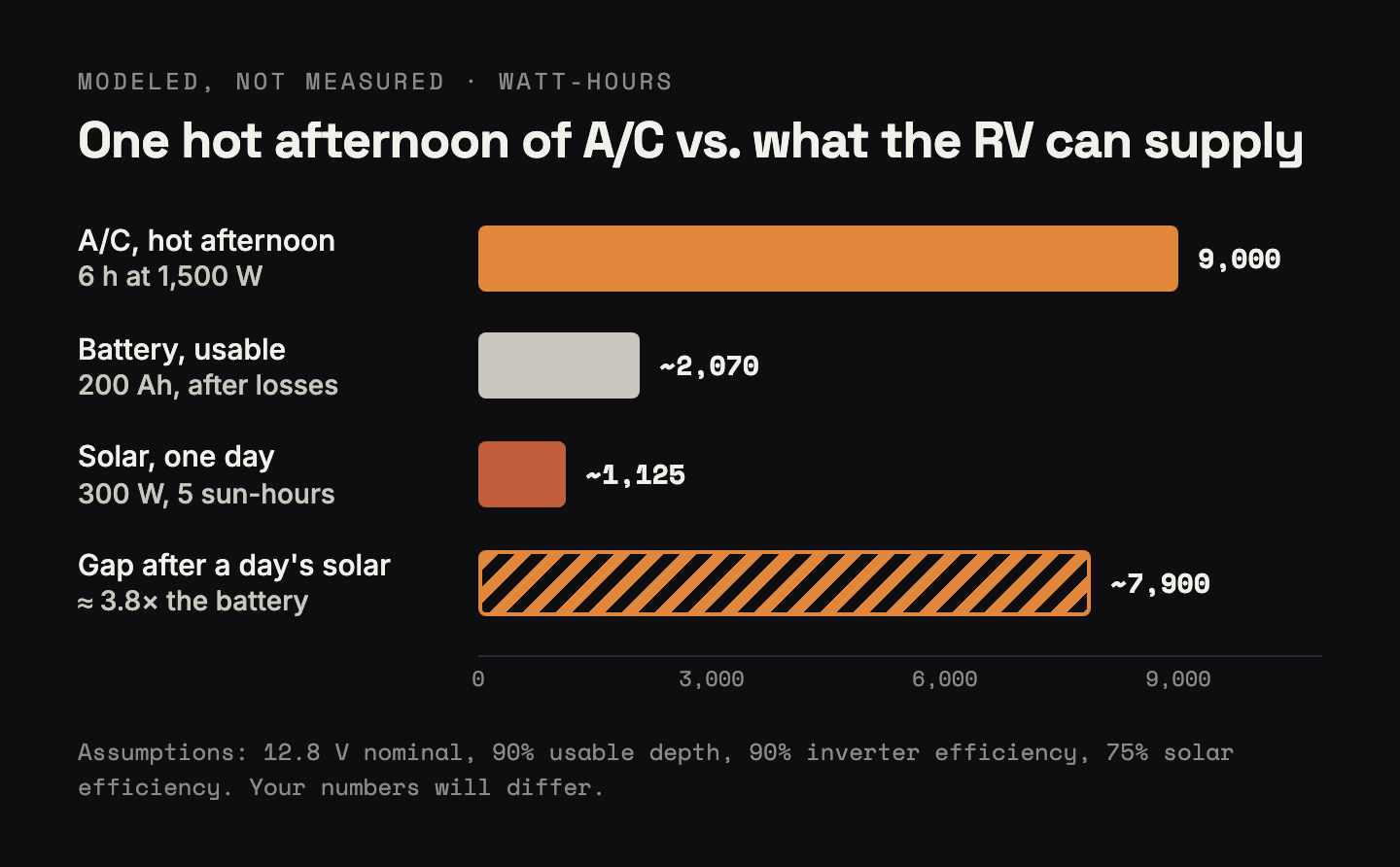
- Battery: 200 Ah at about 12.8 V nominal is about 2,560 Wh. Allow for the depth you can actually use and for inverter losses (I used 90% for each) and about 2,070 Wh reaches the A/C.
- A/C: a rooftop RV unit draws roughly 1,200 to 1,800 W while it runs.
- Runtime: 2,070 Wh at 1,800 W is about 1.15 hours. At 1,200 W it is about 1.7 hours.
- Solar at its best: 300 W at noon in full sun covers about a sixth to a quarter of what the A/C draws.
- Solar over a day: 300 W for 5 peak-sun hours, at 75% real-world efficiency, is about 1,125 Wh.
- A hot afternoon: say the compressor runs 6 hours at 1,500 W. That is 9,000 Wh.
Put those together. The day's solar covers one eighth of that afternoon. The gap, about 7,900 Wh, is nearly four times what the battery can deliver. To cover it from storage you would need about 760 Ah of battery.
What the battery is good for
The research still left the battery a job. Its conclusion was that this kind of setup can cover the small loads for a festival weekend: the fridge, lights, the water pump, fans and charging devices. The A/C was the one load it ruled out.
Without a hookup, then, the RV is a place to sleep with lights and a cold fridge, and with no A/C.
The parts that were not magic
A battery several times larger would still have only 300 W of panels to refill it.
The rules were easy to find, because the festival publishes them plainly. The softer details were harder to pin down: how each camping zone feels, how dusty it gets, how far the walk is. Much of that came from festival guides that collect attendee advice, not from the festival itself.
If you are about to try this
- Read the festival's power rule before anything else. If generators are banned, look for a line about built-in units. It decides which camping options are worth looking at.
- Do the A/C math with your own numbers. Watt-hours in the battery divided by the A/C's running watts gives you hours. If the answer is one or two, cooling isn't part of the boondocking plan.
- Treat solar as a top-up for small loads. Compare your array's peak watts with the A/C's running watts before you count on it.
- Ask the organizer what the "power" is. The amperage, and the plug type on the pedestal.
Build it yourself
What it does: tells you, before you book, whether your RV can keep its A/C running at an event with no generators and no hookup, and how big the gap is. You need four numbers: battery capacity in Ah and its voltage, solar array watts, and the A/C's running watts. You can read them off the spec sheet or the unit's label. A spreadsheet works, or a few lines of code:
# your numbers
ah, volts = 200, 12.8 # battery
solar_w = 300         # array
ac_w = 1500           # A/C running
ac_hours = 6          # per day

# assumptions
usable = 0.9 * 0.9    # depth, inverter
sun_h = 5             # sun hours
eff = 0.75            # solar losses

bat_wh = ah * volts * usable
sol_wh = solar_w * sun_h * eff
gap_wh = ac_w * ac_hours - sol_wh

print("A/C hours:",
      round(bat_wh / ac_w, 2))
print("Gap (Wh):", round(gap_wh))
print("Ah needed:",
      round(gap_wh / usable / volts))
If the battery runs the A/C for under a couple of hours and the daily gap is several times the battery, a serviced site is the only way to have A/C there.
If you have run an RV at an event without a generator, I would like to hear how you kept cool.