
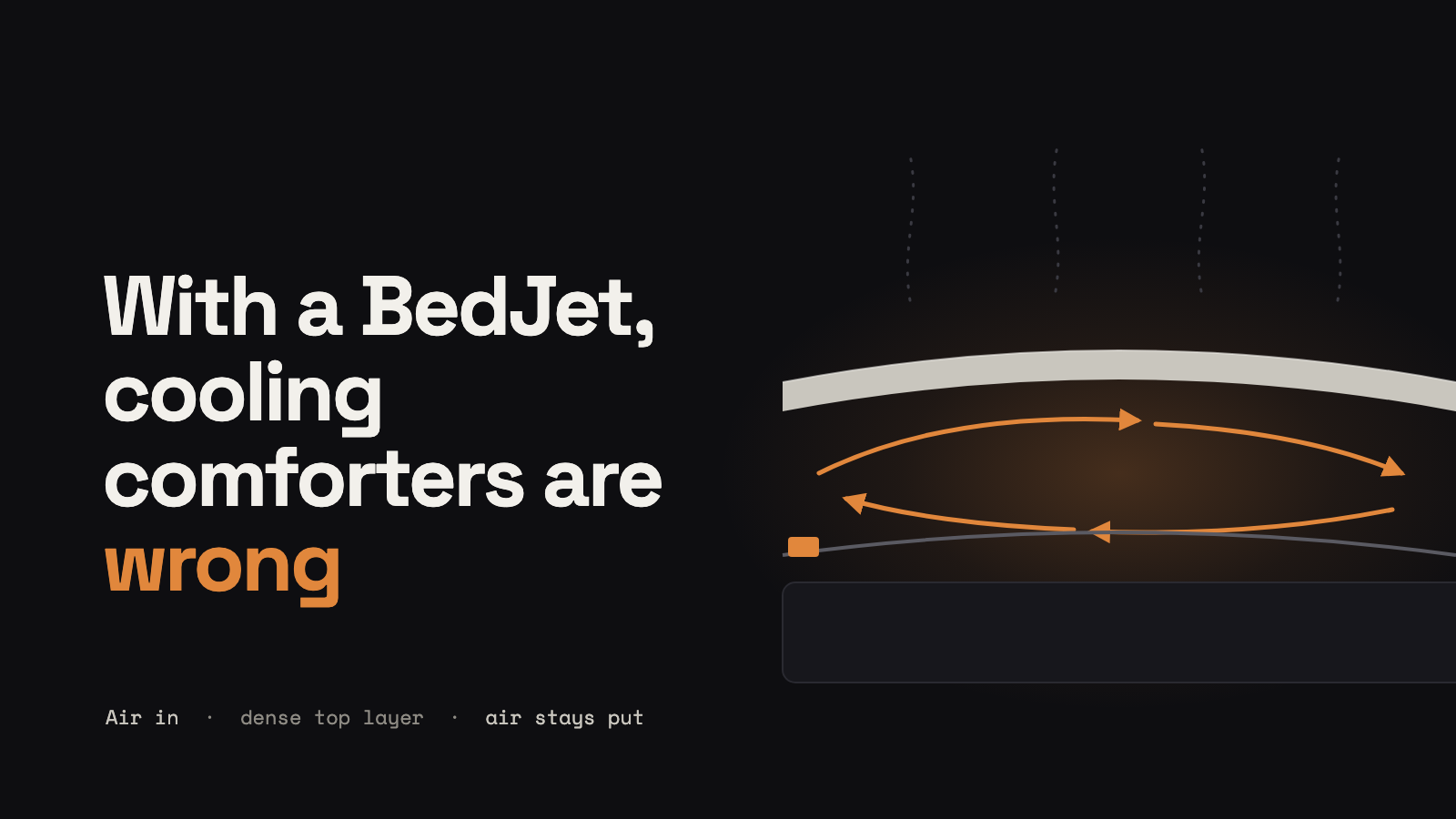
In July 2026 I went looking for the best cooling comforter for an Arizona summer, and the answer turned out to be that I shouldn't buy one. The bed has a BedJet, which blows heated or cooled air under the covers. On a bed like that, the top layer has one job: keep that air in.
The answer was a plain comforter in a dense cover. Getting there took one correction from me halfway through the research.
The BedJet setup
The BedJet is a climate unit that pushes conditioned air under the covers, through a nozzle that plugs in at the foot or the side of the bed. It can cool or heat.
In July the bedding was a stack, bottom to top:
- A cotton sheet on the mattress.
- The BedJet Cloud Sheet, a cotton top sheet with air channels sewn in, so the air spreads across the bed.
- A duvet-covered comforter on top of that.
The bed was a King, and top-of-bed items for it were bought in California King. A Cal King is longer and a bit narrower, so on a King frame it hangs further over the foot of the bed. That extra overhang was the reason.
The BedJet is still part of the bed in October 2026.
The question I asked was the wrong one
The question I asked was generic: which cooling comforter is actually best for desert heat, and does anything use a mechanism that lasts, as opposed to a marketing finish. The research that came back was good, as research about the generic question.
- Only four sources ran instrumented tests. The rest were affiliate lists. Wirecutter had no cooling-comforter pick at all.
- Cool-touch shells are a short trick. The nylon and spandex fabrics are the weakest mechanism on offer: the cool feeling lasts about a minute, and they are the least breathable shell class.
- In the Arizona subreddits, nobody recommended a cooling comforter. The local answer was percale or linen sheets, a thin cotton layer, a ceiling fan and the AC.
The generic advice that came out of all this: percale around 200 to 300 thread count, or a lyocell shell, light fill, and natural fibers that breathe.
That would have been the wrong comforter for my bed.
The correction that flipped the answer
Partway through I pointed out what the research didn't know yet. The bed was a King. A BedJet was already installed. And the new comforter would go on top of the Cloud Sheet, not replace it.
The cooling was solved in hardware. What was left was a containment problem.
BedJet's own product page says the Cloud Sheet works best under heavier bedding, a blanket, quilt or comforter, because that helps the air spread evenly and stops warm or cool pockets forming down by your feet. Put a breathable layer on top and the air the BedJet just conditioned goes up through it into the room, whether it is cooling or heating.
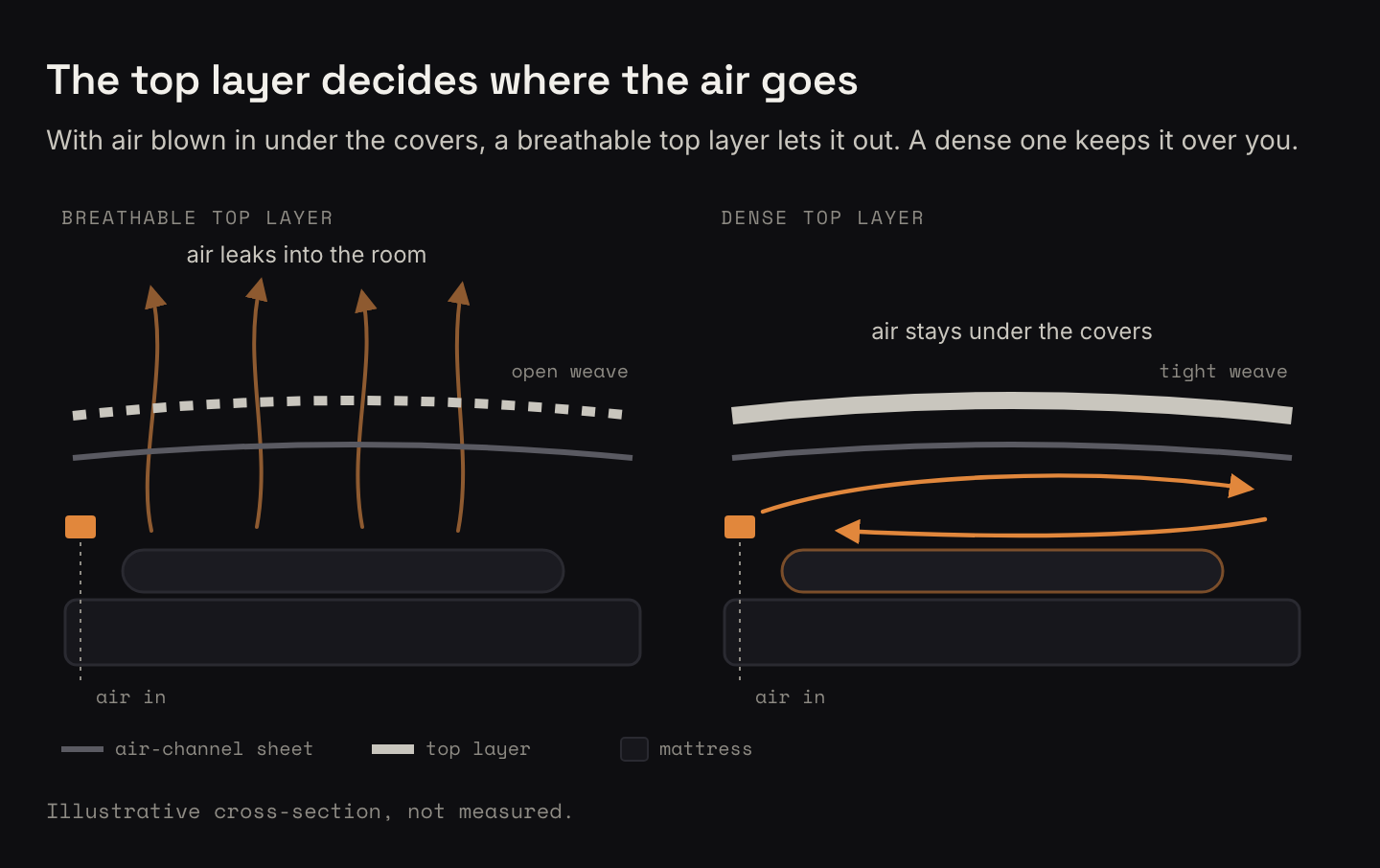
So the list of things to avoid on this bed: "cooling" comforters, linen, gauze, waffle weave, jersey knit, low-thread-count percale under about 250, and the synthetic cool-touch fabrics. Every one of them leaks the airflow.
What I picked
A normal down-alternative insert in a tight-weave cover. The specific choice was a LaCrosse LoftAIRE down-alternative insert in Cal King, with a sateen cover. Three things decided it:
- BedJet compatibility. This was the deciding criterion, ahead of any cooling claim.
- Cal King, for the overhang at the foot.
- A durable mechanism.
I'm writing about the choice here, so there is no verdict on how the LoftAIRE sleeps.
The part that was not magic
The research was thorough. As generic advice it held up. The miss was mine: I left out that the bed already had active cooling under the covers, which changes what the top layer is for.
If you are about to try this
- Describe the whole stack before you shop. What's under the comforter decides what the comforter should do.
- With a BedJet or anything else that blows air under the covers, buy a dense top layer. Sateen or twill, not linen, gauze, waffle or jersey.
- Be suspicious of "cooling" claims that rest on a finish or a cool-touch feel. Ask what the mechanism is and how long it lasts next to a warm body.
- Without active cooling, the generic advice holds.
Build it yourself
What it does: a bed where the temperature comes from a machine under the covers, and the bedding's job is to keep that air where you are. The parts:
- An under-cover climate unit, such as a BedJet.
- An air-spreading top sheet, such as the BedJet Cloud Sheet, so the air reaches the whole bed.
- A midweight comforter in a tight-weave cover, sateen or twill, on top.
How the pieces fit: the unit pushes air in through its nozzle, the sheet's air channels spread it across the bed, and the dense top layer keeps it from escaping up into the room.
If you sleep with a BedJet or something like it and found a top layer that works, I'd like to hear what it is.