
In July my patio misters kept switching themselves on and off. The motion sensor that was supposed to start them read about 118°F on its own case. On July 25 I split the job in two: a camera that can detect people started the water, the motion sensor was only allowed to keep it running, and a hard 30-minute cap sat over both.
A motion sensor sees heat changing, not people
A PIR (passive infrared) motion sensor never sees a person. It sees infrared, and it fires when the amount of infrared across its view changes. A warm body crossing a cooler background makes that change. The sensor's differential design is built to ignore a change that happens evenly across the whole view, so a room slowly warming up should not set it off.
That means a PIR depends on contrast between you and whatever is behind you. Panasonic, which makes PIR sensors, says the main reason for missed detections is a small temperature difference between the body and its surroundings. It guarantees detection when that difference is 4°C (7.2°F) or more.
Around 100°F, the contrast runs out
Panasonic puts a person at about 37°C, or 98.6°F. Apply its 4°C guarantee to that and you get a band, from about 91°F to about 106°F, where a 98.6°F body is no longer guaranteed to stand out from the background. That is my arithmetic on Panasonic's numbers, not a measurement.
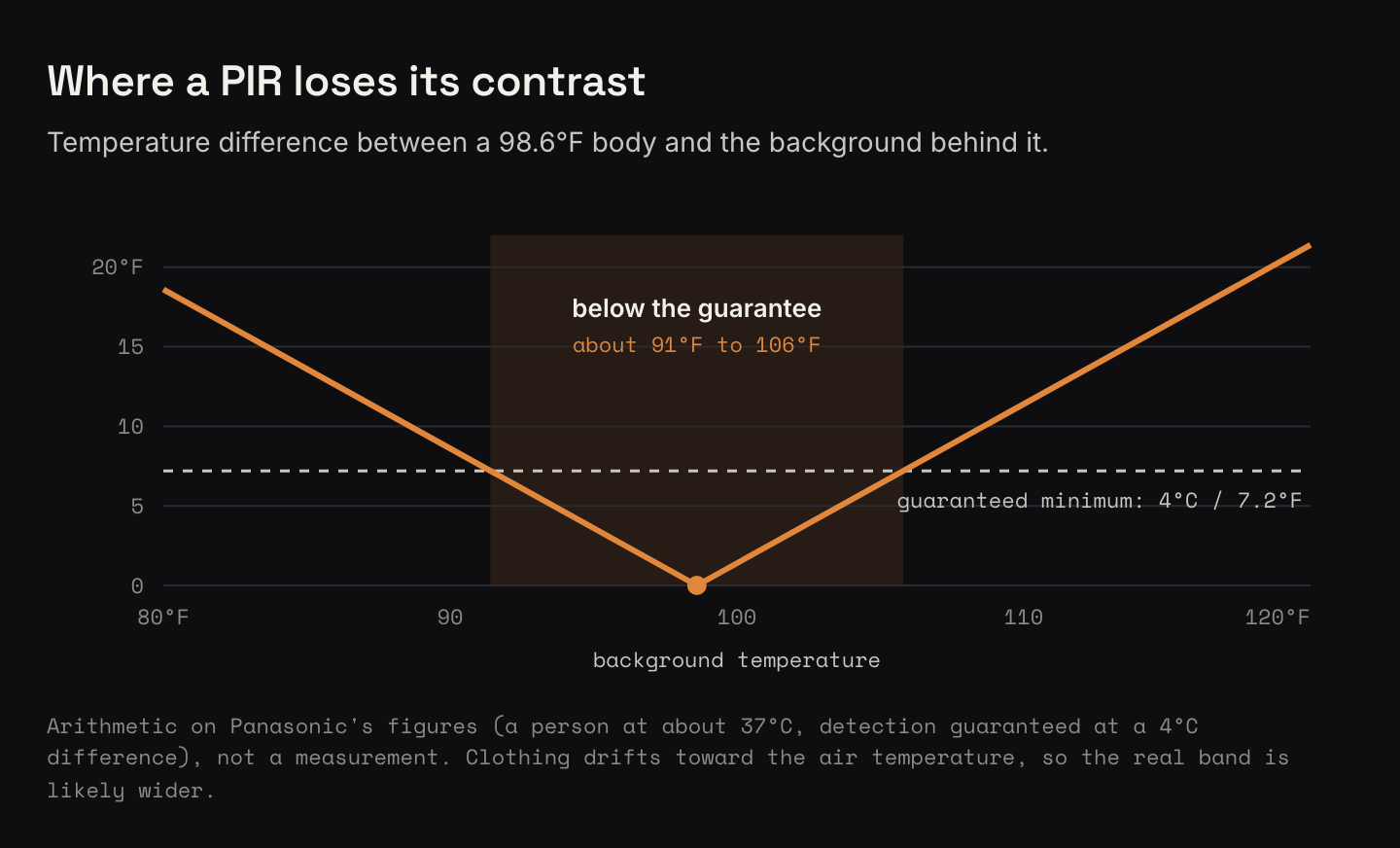
Real people make it worse. Panasonic's own FAQ says sensitivity drops in summer for exactly this reason, and that clothing drifts toward the air temperature, so it hides you even more. Exposed skin is easier to see. So the real band is likely wider than the clean arithmetic suggests.
Instead of missing people, it saw ghosts
The physics says a sensor in that heat may miss people. Mine did something worse: it fired on its own. The misters cycled over and over.
The logs pointed to a loop. Once the sensor tripped, the misters came on and threw a plume of cool spray across its view. Air on its own is close to invisible to a PIR, but Panasonic notes that airflow which cools the lens or quickly shifts the background temperature can trip one. A cool plume moving through a hot background is a fast change in heat, which is the one thing this sensor exists to report. So the water kept re-triggering the sensor that started the water.
That was my read, from the history. The fix didn't depend on it being exactly right. Whatever the exact cause, the motion sensor could not be trusted to start the water in that heat.
Start, hold, cap
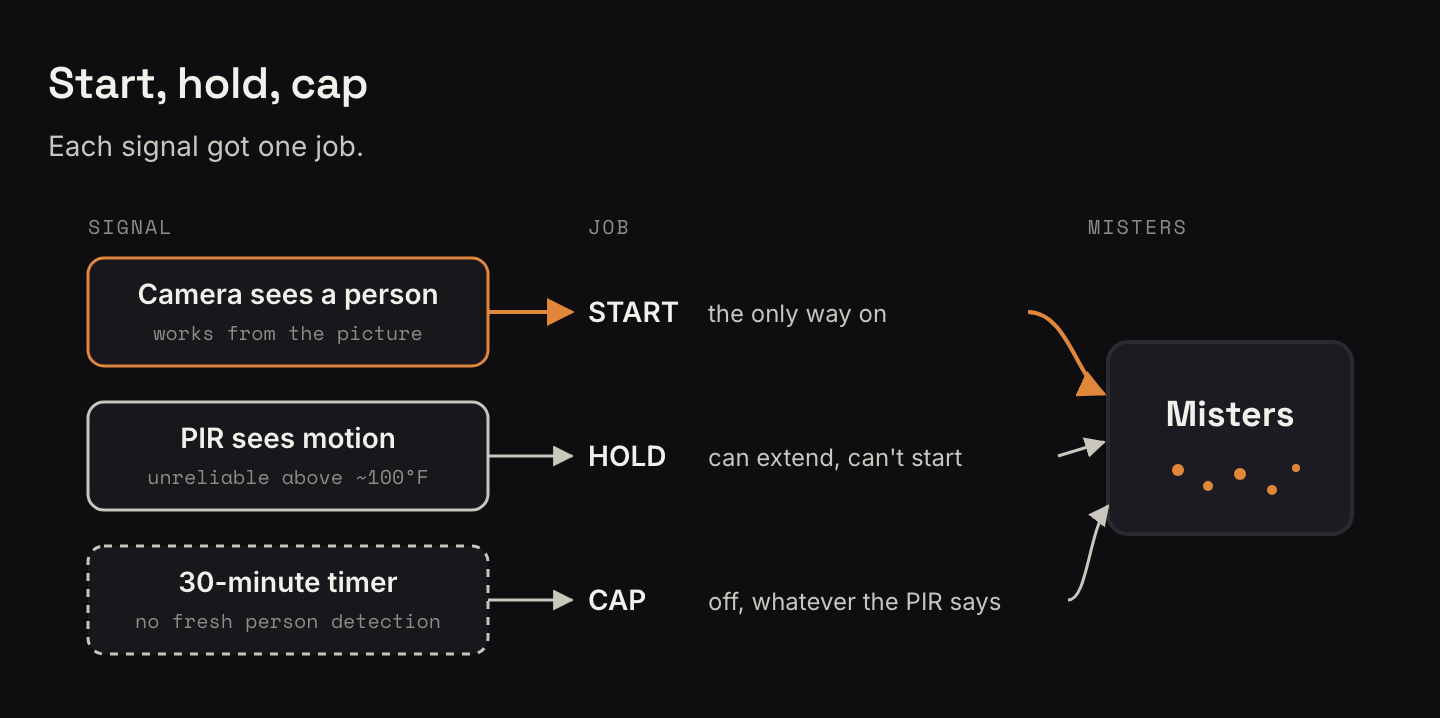
On July 25 I gave each signal one job.
- Start: a camera that can detect people. Person detection works from the picture, not from heat, so it doesn't need the thermal contrast a PIR loses. The motion sensor was removed as a way to turn the misters on.
- Hold: the motion sensor. It stayed in the logic that turned the misters off, as an extender. Motion kept a run going a little longer. It could no longer begin one.
- Cap: 30 minutes. If the misters had run for 30 straight minutes with no fresh person detection from the camera, they went off, whatever the motion sensor said.
A sensor that fires on its own spray can hold the water on forever. The 30-minute limit put a ceiling on how much water one bad hold could cost.
If you are about to try this
- Do the contrast math for your climate. If your air or surfaces regularly sit within about 7°F of body temperature, don't use a PIR as the only way to start anything.
- Give each sensor one job. Let the most trusted signal start things. A weaker signal can extend a run, and only if something else caps it.
- Cap anything that runs water. A hard time limit is cheap insurance.
- Test in the worst conditions. For a PIR outdoors, that means the hottest part of the day, with the device it controls running.
- Keep the output out of the sensor's view. Spray, fans and heaters all look like heat moving.
Build it yourself
What it does: turns patio misters on when a person is actually outside, keeps them on while that person is around, and shuts them off within a fixed time. The parts:
- Misters on a smart switch or valve that your home automation can turn on and off.
- A camera that can detect people, with its detections available to your automation system.
- An outdoor PIR motion sensor, optional, used only to extend a run.
- Home Assistant, or any automation system that can combine triggers, conditions and timers.
How the pieces fit: a person detection starts the misters. Motion, if you use it, can only delay the off timer. A separate timer turns the misters off after a fixed run unless there has been a fresh person detection.
If a sensor of yours has ever failed in the heat, I would like to hear what it was doing.