
When I build a "best of" playlist of an artist's live sets, fans' upvotes decide which sets go on it, and the source of each recording decides which version to use. I worked these rules out on a Tipper playlist in October 2026: 28 fan threads tallied by upvote, 50 candidate recordings, and a 14-set list ordered as a journey. Exactly one of those sets had an official lossless release.
Sets and mixes, never songs
The first rule sounds obvious and is the easiest to get wrong: full live sets and DJ mixes only. No single tracks, no album uploads, no clips, no fan compilations. An artist's own channel is mostly songs. On Tipper's official YouTube channel, 183 of 185 uploads were single tracks, so only two of them could go on the list.
The artist's own mixes and official uploads are the core of the list. They usually have the best audio.
Upvotes are the vote, counted carefully
I let the community decide which sets matter. The artist's subreddit has plenty of "best set" and "where to start" threads, and every recommendation in them comes with a score. The tally rule is simple: a set's weighted score is the sum of the upvotes on every comment that recommends it, across all the threads.
Counting carefully took a few more rules:
- One comment, one vote per set. A comment that names a set three times still counts once.
- A floor and a zero. A comment scored 0 or 1 still counts as 1. A downvoted one counts as nothing.
- Posts tracked separately. When one popular post names a set in its title, its score is kept in its own column, so a single viral post can't pass for broad agreement.
- One name per set. Fans call the same set by its venue, its night number or a nickname. Hand-written alias rules folded those into one entry.
The post column changed how I read the top of the table. The top set scored 441 from 59 mentions, and only 29 of those points came from posts. The official sunrise release tied for second at 404, but 182 of its points came from a single post. The two scores look almost the same, and they mean different things.
Full length, and one best version
A set has to be complete, which in practice meant about 40 minutes or more. Partials are out: a recording of only the last 53 minutes of one show didn't make it, and for another I used a full 60-minute upload over a 52-minute cut of the same set.
The floor is there to catch partial live recordings. Two of the artist's own mixes ran 30 and 39 minutes, and they went in anyway, because an official mix is complete at whatever length the artist made it.
Then each set gets one version, picked by source, in this order:
- Official release.
- A radio or web broadcast.
- A good audience recording.
- Phone audio, only for a legendary set with nothing better, and flagged.
Every entry was checked for full length and that it played.
Order it like a DJ set
A ranked list front-loads the peaks, so the list is ordered as a journey instead. The Tipper list opened on an ambient sunrise set, moved through downtempo, went back to the old-school breaks era, climbed into the 2024-25 peak shows and the final Red Rocks set, and closed on a two-hour ambient comedown.
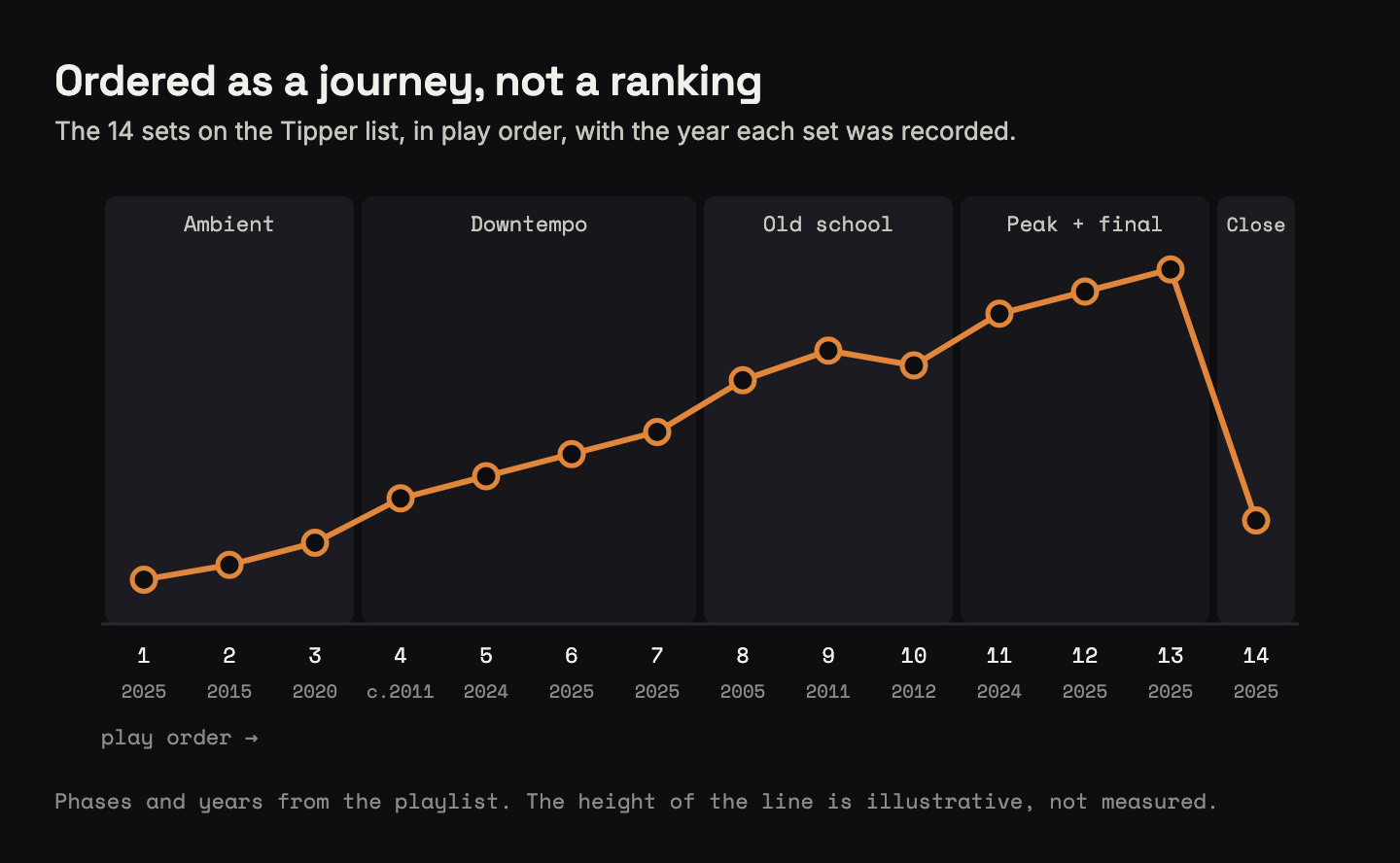
Era variety mattered too. The 14 sets ran from a 2005 radio mix to a 2025 finale, each between about 45 minutes and just over two hours. A second, 11-set version of the list carried the artist's official mixes from 2006, 2008 and 2011.
The honest result: almost nothing is officially lossless
Of the 50 candidates, 13 were the artist's own uploads or releases, 12 were soundboard recordings, 23 were audience recordings, and 2 were phone audio. Only one set, Sunrise At The Gorge, had an official lossless release, at 24-bit/44.1 kHz. For most of the festival sets, fan recordings were the only option.
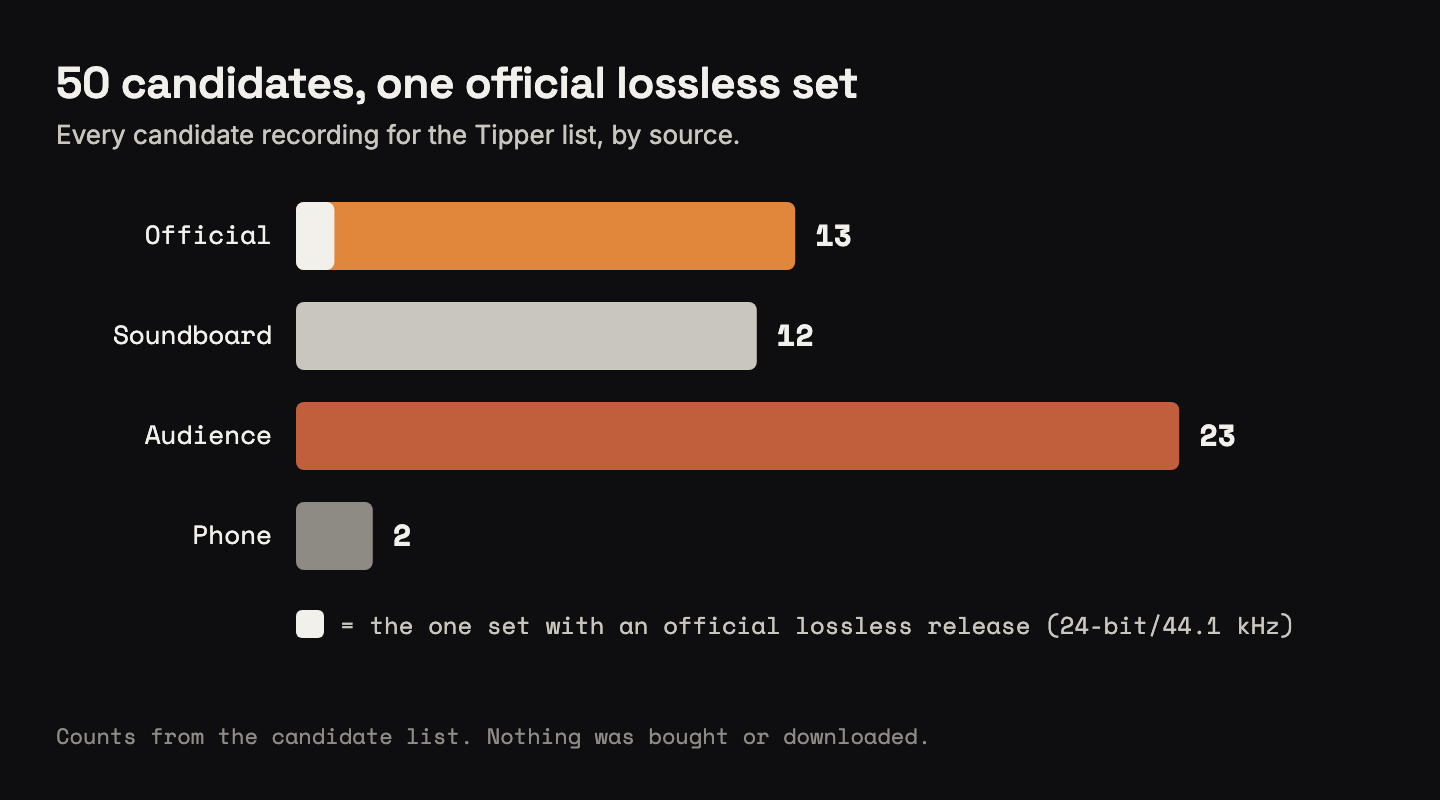
The lossless check was a list: what exists, where it is sold and in what format. Nothing was bought or downloaded.
The parts that were not magic
The votes leaned toward recent sets. Eight of the top 10 sets in the tally were from 2024 or 2025, with the heaviest pull toward the 2025 farewell run. I corrected for it with era variety and kept the votes, and the list still landed with 8 of its 14 sets from those two years.
Where I was the bottleneck
The first brief asked for live sets, and it still needed two addenda from me. The first: "I want mixed and live sets by Tipper himself too." The second was two words: "Not songs." Both became the first two rules.
If you are about to try this
- Write the exclusions first. Full sets and mixes only, no songs, no clips. Writing that down saves a round of fixes.
- Keep post scores apart from comment scores. One viral post can look like a consensus.
- Normalize set names by hand. Fans give the same night several names.
- Set a length floor, and exempt official mixes.
- Expect recency bias. Fix it with era variety instead of throwing out votes.
- Treat lossless as a report. For most live sets, the honest answer is that no official lossless version exists.
Build it yourself
What it does: turns a community's opinions into a playlist of an artist's best full sets, with the best available version of each, in an order that flows. The parts:
- Threads where fans recommend sets, read only. Never post or vote to shape the result.
- A tally sheet: one row per set, with mentions, weighted score, the share from posts, date, venue and recording type.
- Alias rules that map nicknames and night numbers to one set.
- A source ranking: official, then broadcast, then audience, then phone.
- A length check on every pick, plus one or two backups.
- An arc: a few phases (ambient, downtempo, older eras, peak, finale, comedown) to slot the picks into.
How the pieces fit: the tally picks the sets, the source ranking picks the version, and the arc picks the order.
If you have a set you think every "best of" list gets wrong, I would like to hear which one.